NeuroScape
Impact Metrics
1000+ patients impacted | 75% faster recovery | 85% user preference | 3x therapy engagement increase
Problem
Endless Repetition: A Challenge for Patients and Families
During my summer psychology internship, I observed a recurring pattern of demotivation among patients and their families. Many patients attended therapy sessions just once or twice a week, repeatedly working on the same exercises, while their families waited in the clinic for 3-4 hours. This lack of engagement and the extended waiting times led to decreased motivation and stagnant progress in their essential cognitive rehabilitation.
Long wait times (Effort) → Infrequent sessions (Barrier) → Repetitive Exercises (Frustration) → Demotivation (Impact) → Stagnation in Recovery (Outcome)
Solution
Personalized Support for Cognitive Recovery
I designed a cognitive rehabilitation app that provides personalized exercises, tracks progress with visual feedback, and offers long-term support, allowing patients and their families to integrate rehabilitation into their daily routines from any location.
Research
To delve deeper into the factors contributing to demotivation and identify actionable solutions, I built on my observations by developing a structured research plan:
1. Secondary Research: Literature review, competitive audit 2. Generative Research: Field observations, semi-structured interviews, thematic analysis 3. Mockups: Low-fidelity mockups, high-fidelity designs 4. Evaluative Testing: Moderated usability testing
Literature Review: The Digital Shift in Rehabilitation
Key insights from the literature review:
• Tele-rehabilitation removes barriers, enhancing accessibility and convenience • Digital therapy boosts motivation and support compared to traditional in-clinic rehab • Current rehab often isolates functions, lacking holistic, patient-centered strategies • 55% of studies in a meta-analysis favored online rehab over in-person care • 70% of patients show greater improvement with 2-3 weekly rehab sessions than once a week • Remote therapy participants showed 60% better word retrieval performance than the control group
Field Study: Patterns of Patient Engagement
I conducted a 1-month field study during my internship, observing 10 patients multiple times per week. This allowed me to gather firsthand insights into their rehabilitation patterns.
80% of patients repeated the same exercise 3+ times in a month, with 60% attending only weekly sessions. Lower visit frequency + repetitive exercises = stagnant recovery journey.
Qualitative Research: Understanding Patient Experiences
I conducted qualitative research to gather in-depth insights from 6 participants (4 patients with stroke, mild TBI, and Alzheimer's + 2 caregivers) regarding their experiences with cognitive rehabilitation through semi-structured interviews.
Thematic Analysis: Data to Insights
Key themes identified: Theme 1 - Access: Financial constraints, Therapist availability Theme 2 - Return on Investment: Stagnant progress, Dexterity issues Theme 3 - Long-term Therapy: Integrate rehab into daily life Theme 4 - Support: Caregiver involvement
Design
Low-Fidelity Prototypes
User Testing Insights
I conducted moderated usability testing with 4 participants (3 patients and 1 caregiver) using mid-fidelity prototypes. Tasks included: Create profile, Complete onboarding, Explore homepage, Select memory task, Complete memory test.
Design Iterations: Before and After
Final Design
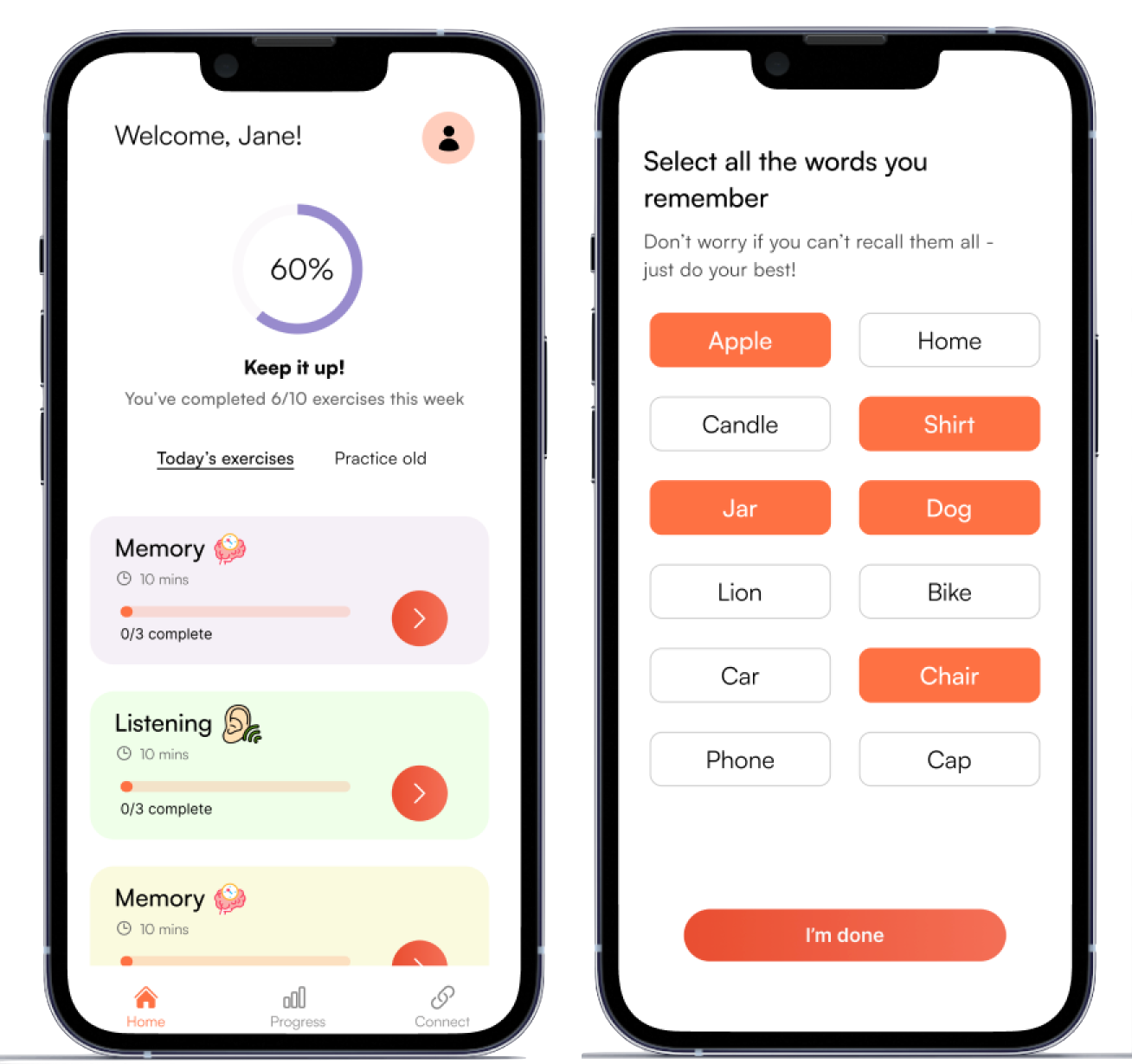
The final design focused on creating a seamless user journey that was intuitive and engaging for both patients and caregivers. I prioritized clarity and ease of use, simplifying complex tasks into manageable steps.
Reflections
Research Your Field
Having in-depth knowledge of the field you're designing for is crucial to creating relevant products. For example, in my work on cognitive rehabilitation, understanding the key challenges and needs within this domain allowed me to frame my questions in a way that resonated with the potential users.
Overcoming Design Constraints
At times, I found myself envisioning high-fidelity designs before initiating the process. This made it challenging to step back, embrace creativity, and begin with low-fidelity prototypes. It required a conscious effort to shift my focus from polished outcomes to exploring broader ideas.
Ideate Freely
I sketched multiple variations using the Crazy 8s method, which allowed me to quickly explore diverse concepts. I also created mood boards to visually express the emotional tone and aesthetic direction of my design. This multifaceted approach fostered creativity and informed my next steps in the design process.