Stripe Merchant Dashboard
Stripe Merchant Dashboard
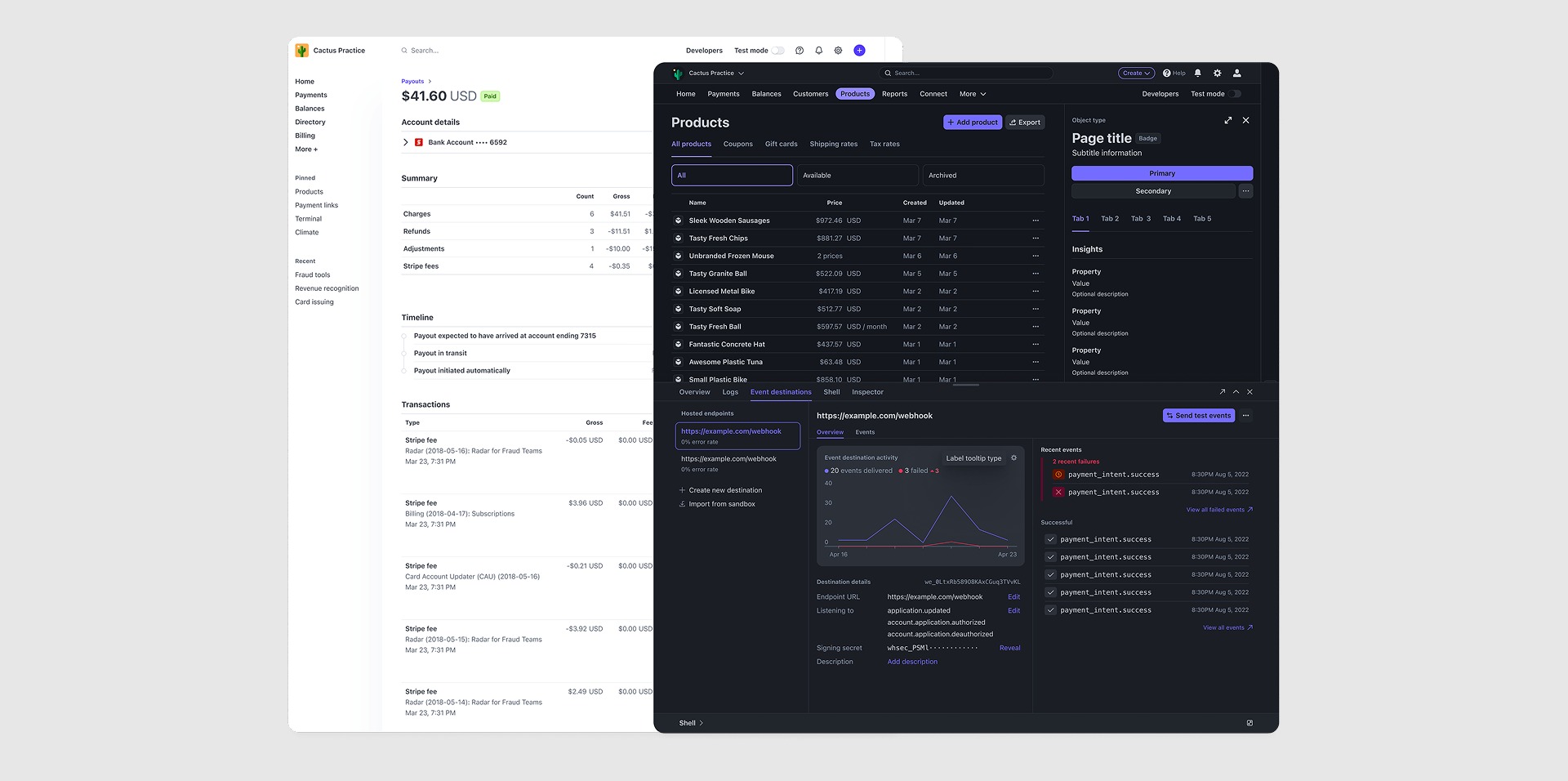
In 2022, I took over leadership of the Stripe Merchant Dashboard team. The merchant dashboard is the center of Stripe's product experience; at that time, more than 1.4 million users relied on the dashboard to run their business. It was a major source of revenue for Stripe too - the company generated more than $4 billion in revenue from SaaS delivered via the dashboard.
Despite this, the dashboard was starting to show signs of age. User satisfaction was declining, and the decentralized nature of the product meant that many teams were working on their own versions of the dashboard, leading to a fragmented experience. With my leadership, the team set out to unify the dashboard experience, simplify the information architecture, and set up the product for future growth.
Design System
I chartered a plan to migrate 100% of the dashboard's codebase to the latest version of the design system, and managed the effort by coordinating dozens of teams over the course of two years. Tactically, we provided dozens of templates and AI-powered migration pathways that allowed engineering teams to seamlessly migrate their product experiences.
Because we built all of the components to be fully themable, this design system served as a backbone for Stripe Embedded Components - enabling merchants to seamlessly embed Stripe's dashboard functionality into their own apps, matching it to the look and feel of their product.
Responsiveness
One of the most challenging aspects of the migration was making Stripe's dashboard responsive. Complex design patterns like tables, filter controls, and modal dialogs had to be adapted to small screens in a way that preserved information architecture and common pattern recognition.
Theming & Dark Mode
With Stripe's reputation for quality to uphold, my team focused on the details of a truly excellent dark mode: one that would not only look aesthetically pleasing, but also be accessible and intuitive in all contexts.
Accessibility
I developed a new approach to automatically generating color tokens based on the WCAG color contrast algorithm. I also worked with Stripe's policy team to develop and implement a global accessibility policy across the organization.
Impact
We didn't simply modernize the dashboard; by going above and beyond the status quo we created entirely new business lines for Stripe. In 3 months after implementing our accessibility policies, I helped close over $10 million worth of new SaaS partnerships with customers with stringent accessibility standards. Visits from mobile devices grew sharply, and experience quality improved substantially.