Xiaomi's Platform Experience
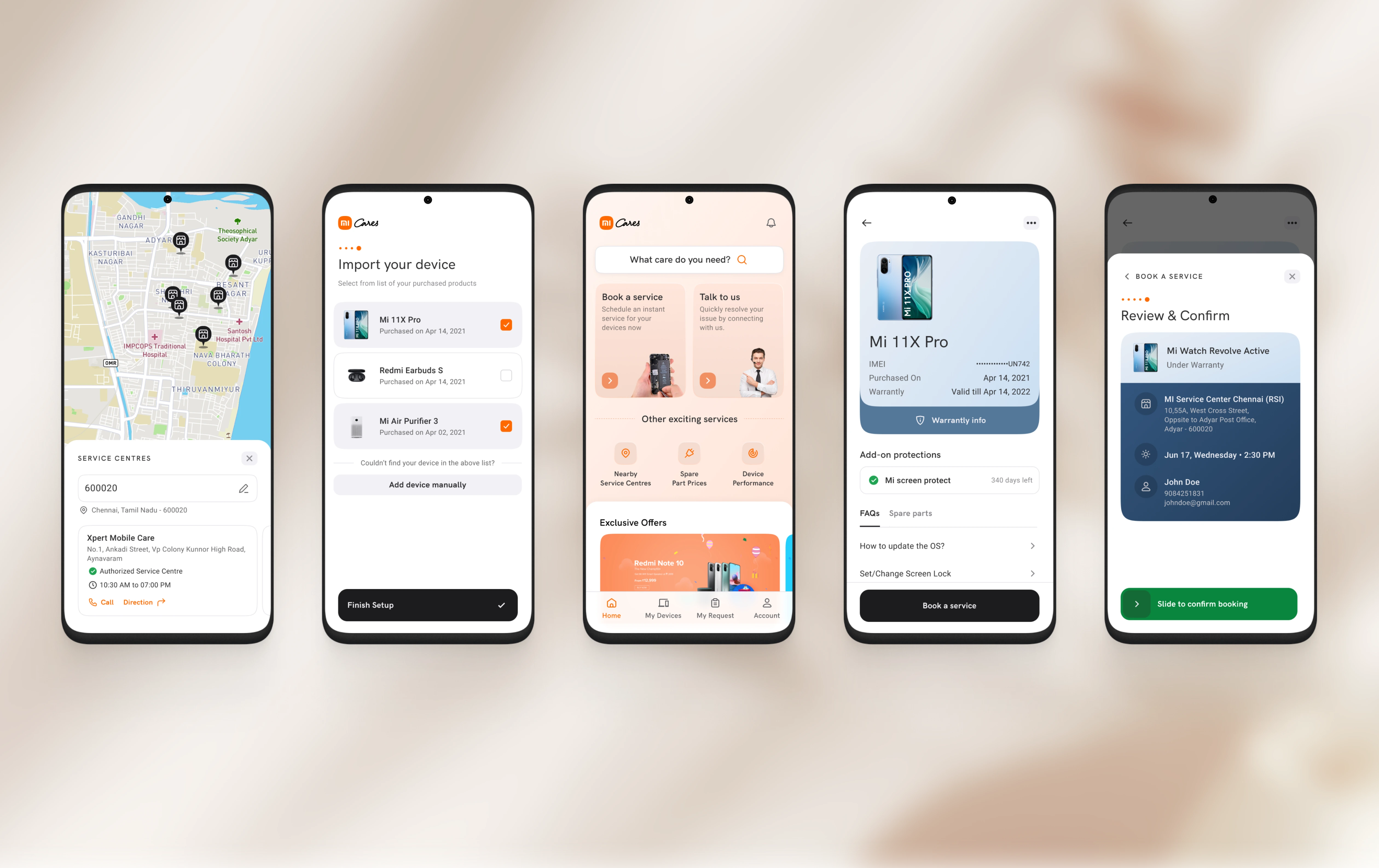
Overview
Context
During the 2020 lockdown, Xiaomi experienced a surge in after-sale service demand due to increased device usage. Customers had several options to resolve issues—visiting service centers, calling support, or browsing FAQs. However, these options were fragmented and lacked a unified, mobile-first experience, especially for Xiaomi’s predominantly mobile-native customer base in India.
Problem
Despite multiple support channels, Xiaomi’s after-sale ecosystem remained disjointed, inefficient, and hard to scale. There was a clear opportunity to consolidate support services into a single, user-friendly mobile interface that streamlined issue resolution and improved customer satisfaction.
My Role
As the sole UX designer contracted for 3 months, I collaborated closely with a product manager and a mobile app developer to:
- Translate business and tech needs into a user-centered mobile support experience.
- Conduct ideation workshops via FigJam to align on scalable design directions.
- Define a scalable component system and deliver a high-fidelity interactive prototype in Figma for development handoff.
Background
What care a consumer needs after purchasing a new device?
- Which is the convenient way for the consumer to connect with a service assistant for resolving their device issue?
- How is the consumer need been addressed?
- Will a consumer continue their engagement with the brand?
These are some of the critical questions that evaluate the after sale aspect of any device. But the consumer has lot of question after purchasing a device.
Stakeholder Requirements
Insights from the Internal Stakeholders
I kickstarted by setting up a meeting with all key internal stakeholders, which included product manager, software architect, mobile app developers, tester and people from marketing team to understand what works well in the existing system and what doesn’t. This cross functional team discussion helped me to understand the technical and business constraints of the product.
Knowledge about their device and its issues
Xiaomi currently has lot of fruitful after-sale information about each devices for their customers. Consumers with zero device knowledge couldn’t find the right lead to approach the customer service. However discoverability was the key issue here.
Funneling service type by issue severity
In the current scenario, majority of Xiaomi consumers fix any issues by simply visiting a service centre nearby. Though there are multiple easy ways to fix the issues, there is no proper funnel for consumers to pick the efficient ways to address their issue.
Engagement and Retention
The after-sale experience flow is incomplete without the retention of the consumer to use the brand continuously. Customers should feel in control on their products while having a prolonged engagement with a brand.
Guiding Design Principles
The team started out to define the design principle by having a high level zoomed out look at the critical touch points in both Xiaomi devices’ sales and after sale scenario.
Restructuring the Information Architecture
We broke down the information architecture into multiple clusters based on the design principle and priority as the product need to hit the market by Nov 2021.
Insightful
Providing users with meaningful, contextual information about their devices and issues.
Convenient
Making it easy for users to find and access the right support channels quickly.
Progressive
Guiding users through increasingly specific steps to resolve their issues efficiently.
Engagement
Retaining users within the ecosystem through meaningful post-purchase interactions.
Feature: Onboarding
In the current system, the information are organised feature-wise collectively.
This group don’t help the user! A Xiaomi Air Purifier customer don’t care about hair trimmer spare part price.
From the discussion with the internal stakeholders, we identified that, during the purchase of any Xiaomi devices from an authorized seller, the user had provided either their email address or mobile number or Mi ID for authentication purpose.
“Feature-wise” to “Product-wise” grouping
It was evident that we needed a scalable way to hold all the information about a device in a single place rather that collectively showing similar information of all devices. So we built ‘Product Info Page’.
Feature: Book a Service
One of the critical feature in the Xiaomi’s after sale business model is ‘Book a service’.
Issues Identified: Discoverability
The touchpoint for the booking a service is all the way down in the user interface and has no prominent callout.
Sudden cognitive overload
Initially the form has only one input. As soon as the user chooses the value, the form expands with multiple more than 12 input fields stacked vertically.
Component level issues
Designing the booking flow
We considered various factors in prioritizing steps in the wizard flow.
Other Features
We incorporated all the service mechanisms based on the frequency of usage and importance into the home screen of the app.
Future Direction
Customer experience (CX) determines how well the brand serves its community.
Reflections
Though it was a contract basis work that I did for Xiaomi Technologies India, the product & engineering team was always available whenever I had any doubts.